
Sourcing aluminium extrusions isn't just a price comparison exercise. The supplier you pick determines dimensional accuracy, surface finish, delivery reliability, machining behaviour, and total production cost — long after the purchase order is signed. Get it wrong and you inherit twisted profiles, inconsistent anodising, missed deadlines, and a rejection rate that quietly eats your margin.
This guide lays out a structured, step-by-step sourcing framework built around Indian standards, international references, and how experienced procurement teams and OEMs actually evaluate extrusion suppliers.
Step 1 — Define Your Application First
Before anything else: where will this extrusion actually be used? Application drives almost every specification that follows — alloy, temper, tolerance class, and finish.
| Industry | Typical application |
|---|---|
| Architecture | Windows, doors, curtain walls |
| Automotive | Heat sinks, EV battery trays |
| Electrical | Busbars, LED housings |
| Solar | Module mounting frames |
| Furniture | Modular profile systems |
| Industrial | Machine frames, guarding |
| Aerospace | Structural components |
Step 2 — Choose the Right Alloy
The alloy decision sets the ceiling on strength, corrosion resistance, weldability, machinability and surface finish. Commonly extruded alloys in India include:
| Alloy | Typical use |
|---|---|
| 6063 | Architectural profiles |
| 6060 | Decorative profiles |
| 6061 | Structural engineering |
| 6005A | Heavy structural sections |
| 6082 | High-strength applications |
| 6101 | Electrical conductors |
For example, aluminium window manufacturers usually default to 6063-T6 — it offers excellent surface finish, good corrosion resistance, high extrudability, and strong anodizing quality. If strength is the primary driver instead, 6061 or 6082 are more likely candidates. For a deeper breakdown of exactly why the alloy choice matters at the metallurgical level, see our comparison of 6061 vs 6063 aluminium alloy.
In India, IS 733:2025 and IS 5052 define requirements and temper designations for wrought aluminium extrusions — worth checking against whichever alloy you land on.
Step 3 — Select the Correct Temper
Temper describes the mechanical condition after heat treatment. Common tempers include T4, T5, and T6 — for example, "6063-T6" means the material has been solution treated and artificially aged, giving it higher mechanical strength than the same alloy in T5 condition. Choosing the wrong temper can mean premature failure in service, or paying for strength you never needed.
Step 4 — Nail Down Your Design Requirements
Before contacting any supplier, prepare a complete engineering drawing that specifies:
- Cross-section geometry
- Dimensions and wall thickness
- Corner radii
- Critical tolerances
- Length and straightness requirements
- Surface finish requirement
- Hole locations, and GD&T where relevant
Step 5 — Standard Profile or Custom Die?
| Standard profiles | Custom profiles |
|---|---|
|
+ No die cost + Faster delivery + Lower MOQ − Limited shape choice |
+ Weight-optimised + Better aesthetics + Easier assembly, less machining − New die investment, longer lead time |
Step 6 — Understand Die Cost for Custom Profiles
Die cost is driven by profile complexity, whether the section is hollow or solid, overall size, wall thickness, and the number of cavities. Typical die development runs through:
Profile design → die design → tool manufacturing → nitriding → trial extrusion → approval sample.
Step 7 — Check Manufacturing Capability
Press capacity commonly ranges from 700 MT up to 3600 MT — larger, more complex profiles need higher tonnage. Billet diameter typically runs 5" to 10". Beyond the press itself, check whether the supplier also offers:
- Multiple extrusion presses (backup capacity, redundancy)
- CNC machining
- Powder coating and anodising in-house or through a controlled partner
- Fabrication and assembly
- Packaging and an in-house testing laboratory
Step 8 — Verify Applicable Standards
For Indian buyers, the standards most commonly referenced include:
- IS 733 — general engineering extrusions
- IS 1285 — extruded tubes and hollow sections
- IS 5052 — temper designations
- IS 3965, IS 6477 — for specific product categories
For export-oriented projects, EN 755, EN 12020 and ASTM B221 are the common reference points. IS 733:2025 specifically covers chemical composition, mechanical properties, workmanship, testing and delivery conditions for extruded products for general engineering purposes.
Step 9 — Always Request Material Test Certificates (MTC)
A proper MTC should include chemical composition, mechanical properties, heat number, batch number, alloy designation, and temper. Material traceability becomes especially important for engineering, infrastructure, and export projects — don't accept a shipment without it.
Step 10 — Check Dimensional Tolerances
No extrusion holds perfectly nominal dimensions — every profile follows an allowable tolerance band. Typical checks cover width, height, twist, bow, straightness, wall thickness, and squareness, verified against the relevant standard (IS, EN, or ASTM) agreed at the time of procurement.
If you've ever had a profile rejected for sitting wrong on a flat table, it's worth understanding exactly what you're looking at — see our detailed breakdown of straightness vs twist in aluminium extrusion, since the two get confused constantly during incoming inspection.
Step 11 — Choose the Right Surface Finish
| Finish | Why choose it |
|---|---|
| Mill finish | Lowest cost, raw aluminium appearance |
| Anodised | Better corrosion resistance, decorative, more durable |
| Powder coated | Hundreds of colours, UV resistant, strong architectural look |
| Wood finish | Widely used in premium window and door systems |
Step 12 — Discuss Secondary Operations Upfront
Most buyers need more than a raw extrusion. Common value-added operations include CNC machining, drilling, tapping, milling, cutting, punching, bending, welding, assembly, and laser marking. Sourcing extrusion and fabrication from a single supplier often cuts both logistics cost and overall lead time compared to splitting the work across two vendors.
Step 13 — Understand Minimum Order Quantity (MOQ)
Extrusion plants generally enforce a minimum order because press setup time, billet changeovers, and die installation all carry fixed costs regardless of order size. Clarify MOQ, trial-run quantity, and repeat-order quantity before you commit to a supplier.
Step 14 — Compare More Than Just Price
| Parameter | Importance |
|---|---|
| Price | High |
| Delivery reliability | Very high |
| Quality | Critical |
| Technical support | High |
| Response time | Medium |
| Certifications | High |
| Production capacity | High |
| Reputation | High |
| Inspection process | High |
Step 15 — Questions to Ask Before Placing an Order
- Which alloy do you recommend for this application?
- Which temper will actually be supplied?
- Can you provide Material Test Certificates?
- Which standards do you manufacture to?
- What press size will produce my profile, and is it currently free capacity or queued?
- What is the realistic lead time — first order and repeat orders?
- Can you handle CNC machining in-house?
- What inspection reports are provided with each shipment?
- What packaging method will you use for my product?
- What is the expected die life for a custom profile?
- Can you guarantee batch-to-batch consistency across repeat production?
Step 16 — Conduct a Supplier Quality Assessment
A proper supplier audit should look at three layers:
Manufacturing: billet storage practices, die maintenance discipline, extrusion press condition.
Inspection: tensile testing, hardness testing, chemical analysis, dimensional inspection capability.
Process control: temperature monitoring, quenching control, ageing oven calibration, packaging procedures.
BIS guidance for product certification similarly emphasises assessing manufacturing infrastructure, process controls, quality systems, and testing capability before certification is granted — the same criteria are worth applying informally in your own supplier audit, certified or not.
Step 17 — Understand Delivery and Packaging
Extrusions need protection against scratches, bending, moisture, surface damage, and transport impact throughout the journey. Common packaging methods include stretch film, foam separators, wooden crates, pallets, plastic end caps, and general protective wrapping — confirm what your supplier actually uses before the first shipment, not after a damaged delivery.
Step 18 — Check Regulatory Compliance (BIS QCO)
Depending on the product category, mandatory BIS certification requirements under applicable Quality Control Orders have been expanding for several aluminium extrusion product categories, including IS 733-governed products. Compliance deadlines have shifted across successive notifications and corrigenda by enterprise size (large/medium, small, micro), so treat any specific date you read — including in this article — as indicative rather than final.
The Complete Sourcing Flow, End to End
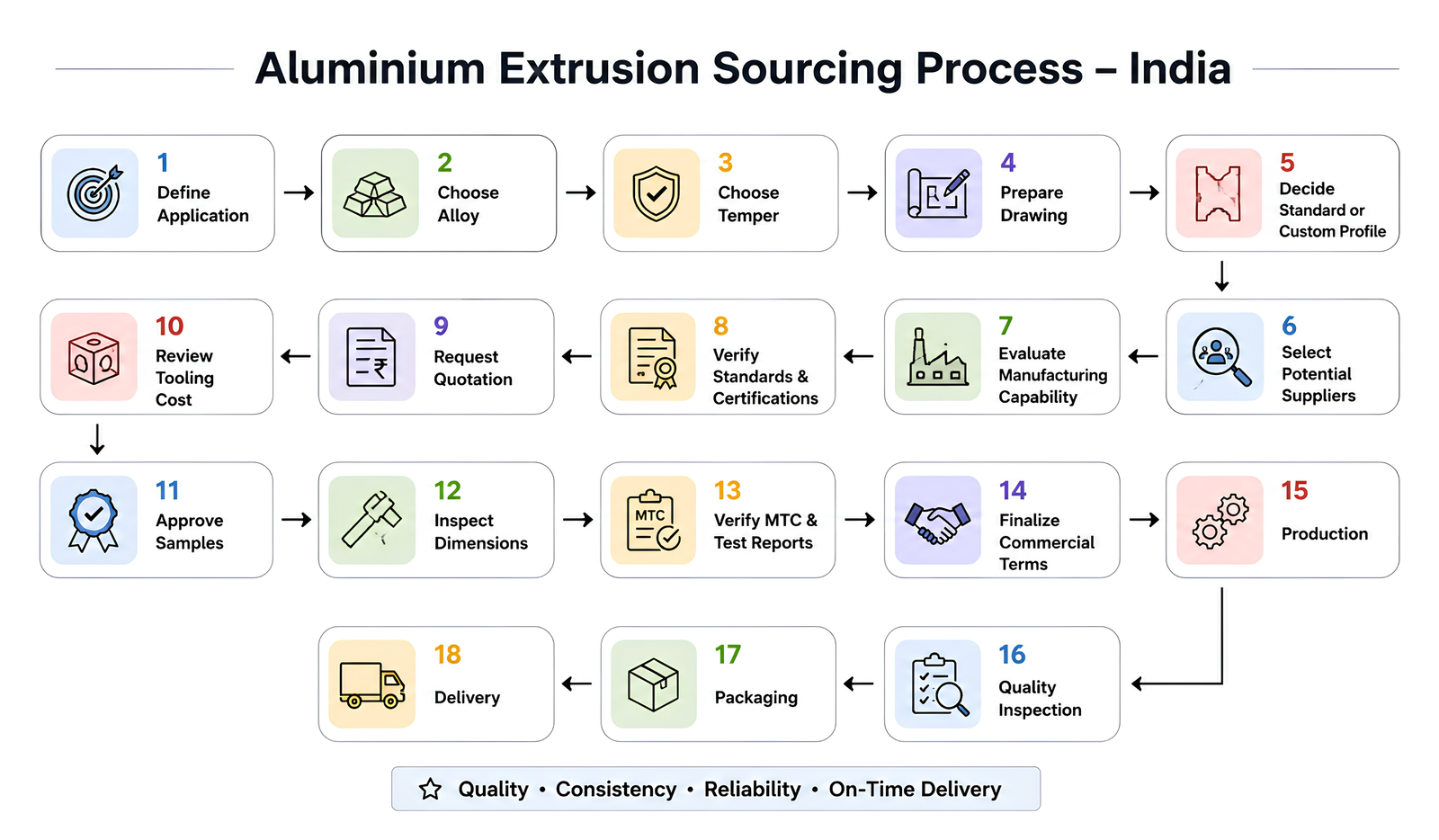
Define application → Choose alloy → Choose temper → Prepare drawing → Decide standard or custom profile → Shortlist suppliers → Evaluate manufacturing capability → Verify standards & certifications → Request quotation → Review tooling cost → Approve first-off sample → Inspect dimensions → Verify MTC & test reports → Finalise commercial terms → Production → Quality inspection → Packaging → Delivery
Common Mistakes Buyers Should Avoid
- Choosing a supplier on lowest quotation alone
- Not specifying the exact alloy and temper required
- Ignoring dimensional tolerance requirements at order time
- Skipping Material Test Certificates
- Overlooking who owns the die, and future die maintenance terms
- Approving full production without a first-off sample
- Not verifying the supplier's press capacity and real technical capability
- Ignoring packaging requirements for long-distance transport
- Assuming every supplier can reliably produce complex hollow profiles at consistent quality
Final Thoughts
Successfully sourcing aluminium extrusions comes down to balancing engineering requirements, quality assurance, supplier capability, and commercial planning. A structured procurement process — alloy first, then temper, drawing, standard verification, and a real supplier audit before the first PO — consistently reduces production risk and lowers total cost of ownership, whether you're buying standard architectural profiles or investing in a custom die for a new product line.
Use this guide as a working checklist for procurement teams, design engineers, OEMs, and anyone sourcing aluminium extrusions in India for the first time — or the fiftieth.
References & Further Reading
- Bureau of Indian Standards — IS 733:2025, Wrought Aluminium and Aluminium Alloy Bars, Rods and Sections (for General Engineering Purposes)
- Bureau of Indian Standards — IS 1285, Extruded Round Tube and Hollow Sections
- Bureau of Indian Standards — IS 5052, Temper Designations for Wrought Aluminium and Aluminium Alloys
- Ministry of Commerce and Industry — Quality Control Order for Wrought Aluminium and Aluminium Alloy Bars, Rods and Sections, and subsequent amendments/corrigenda
- EN 755 series and ASTM B221 — for export-oriented and international specification reference